

How Can We Help?
Office No 1, G Wing, Alok Nagari, 1305 Kasba Peth, Near Urdu School, Lunanagar, Shaniwar Wada, Pawale Chowk, Pune 411011, Maharashtra
Mutual Consent Divorce in Pune: Complete Legal Guide Under Section 13(B)
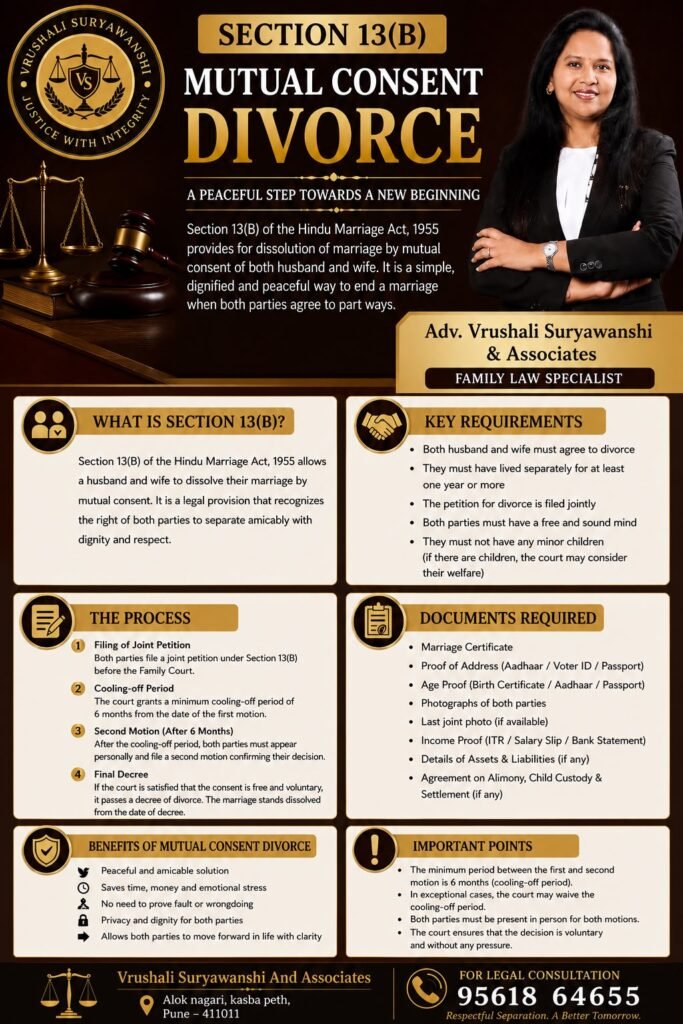
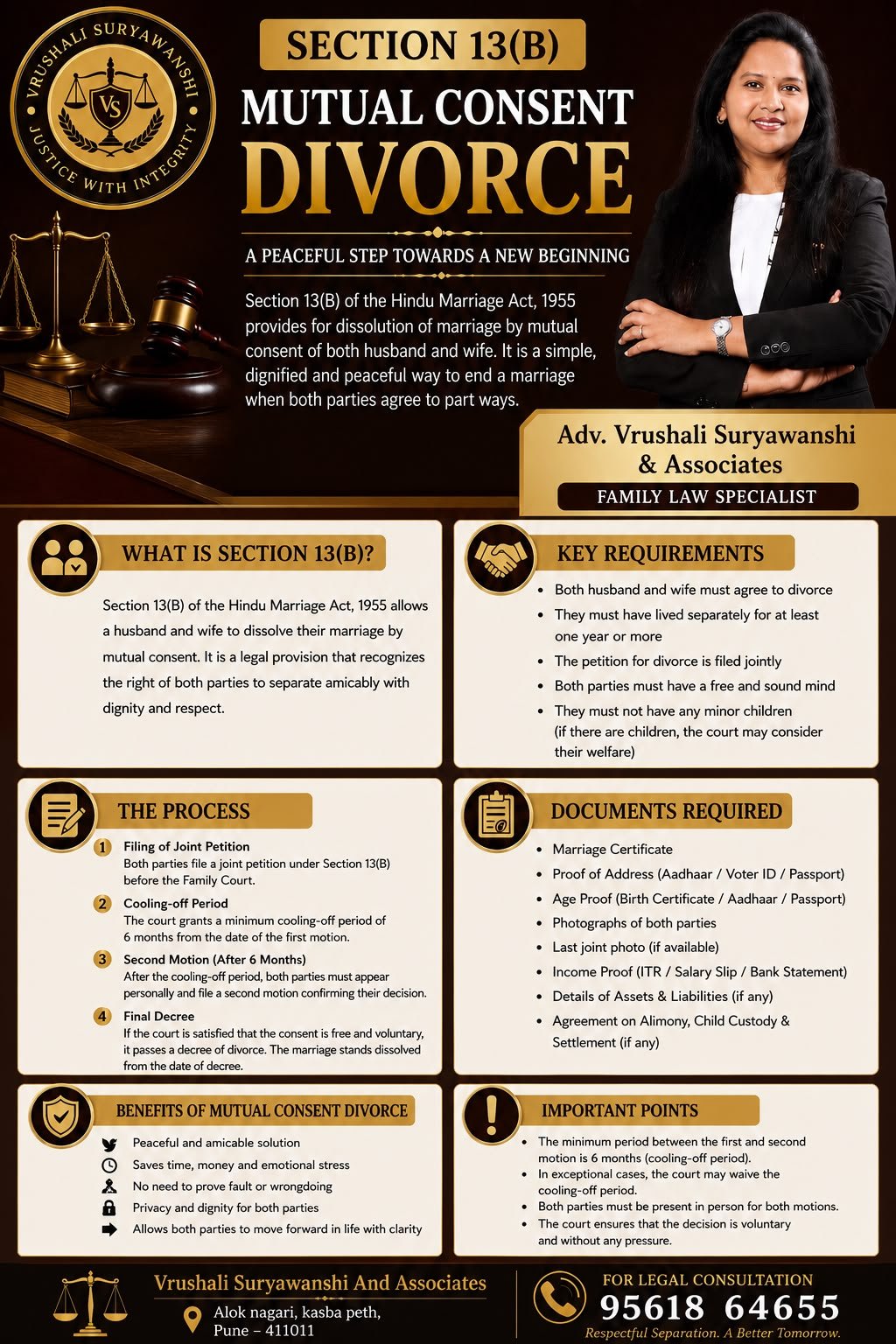
Mutual Consent Divorce in Pune is one of the most peaceful and legally recognized ways for couples to end their marriage when both spouses mutually agree to separate. Governed by Section 13(B) of the Hindu Marriage Act, 1955, this process helps couples avoid lengthy litigation while ensuring a dignified legal separation.
At Advocate Vrushali Suryawanshi & Associates, we provide professional legal assistance for Mutual Consent Divorce in Pune. This guide explains the eligibility, legal process, required documents, benefits, and important considerations involved in filing a mutual consent divorce petition.
What is Mutual Consent Divorce in Pune Under Section 13(B)?
Mutual Consent Divorce in Pune is governed by Section 13(B) of the Hindu Marriage Act, 1955. This legal provision allows both spouses to dissolve their marriage by mutual agreement through the Family Court.
Section 13(B) of the Hindu Marriage Act, 1955 provides a legal mechanism for dissolving a marriage by mutual consent.
Under this provision, both the husband and wife jointly agree that the marriage has broken down beyond repair and voluntarily decide to end the marital relationship.
Mutual consent divorce promotes a respectful separation while reducing unnecessary litigation and conflict.
Who Can File for Mutual Consent Divorce?
A couple may file for mutual consent divorce if they satisfy the legal requirements prescribed under the Hindu Marriage Act.
Generally, the following conditions should be met:
- Both husband and wife mutually agree to dissolve the marriage.
- They have been living separately for at least one year.
- Both parties voluntarily consent to the divorce without coercion, fraud, or undue influence.
- A joint petition is filed before the appropriate Family Court.
- Both spouses are mentally competent to make the decision.
If the couple has children, issues relating to custody, visitation, and maintenance should be resolved before or during the proceedings.
Step-by-Step Process for Mutual Consent Divorce
Step 1: Filing the Joint Petition
The process begins with both spouses jointly filing a petition for divorce under Section 13(B) before the Family Court having jurisdiction.
The petition generally includes:
- Marriage details
- Date of separation
- Reasons for seeking divorce
- Settlement terms
- Child custody arrangements (if applicable)
- Maintenance and alimony details
Step 2: First Motion
After filing the petition, both spouses appear before the Family Court.
The court records their statements and confirms that the decision has been made voluntarily.
Step 3: Cooling-Off Period
Traditionally, a statutory cooling-off period of six months exists between the first and second motions. The purpose is to provide the parties with an opportunity to reconsider reconciliation.
However, in appropriate cases and subject to judicial discretion, courts may waive this period based on the facts and applicable legal principles.
Step 4: Second Motion
After the cooling-off period (or its waiver where legally permissible), both parties appear before the court again and reaffirm their intention to dissolve the marriage.
The court verifies that the consent continues to be voluntary.
Step 5: Final Decree of Divorce
If the court is satisfied that all legal requirements have been fulfilled and the consent is genuine, it grants a decree of divorce.
The marriage stands legally dissolved from the date of the decree.
Documents Required for Mutual Consent Divorce
The following documents are commonly required:
- Marriage Certificate
- Aadhaar Card, Passport, or Voter ID
- Address Proof
- Age Proof
- Passport-size photographs of both spouses
- Marriage photographs (where available)
- Income proof (Salary Slips, Income Tax Returns, or Bank Statements)
- Details of movable and immovable assets (if relevant)
- Settlement agreement regarding:
- Permanent alimony (if applicable)
- Child custody and visitation
- Property division
- Financial settlement
Additional documents may be required depending on the facts of the case.
Benefits of Mutual Consent Divorce
Choosing mutual consent divorce offers several advantages:
Peaceful and Respectful Separation
It enables couples to separate amicably without prolonged disputes.
Saves Time
Compared to contested divorce proceedings, mutual consent divorce is generally resolved more efficiently, depending on court schedules and legal requirements.
Lower Legal Costs
Fewer hearings and reduced litigation can help lower overall legal expenses.
Less Emotional Stress
The process minimizes conflict and allows both parties to move forward with dignity.
Greater Privacy
Sensitive personal matters are generally resolved through mutual settlement rather than prolonged litigation.
Flexibility in Settlement
The parties can mutually decide issues relating to maintenance, child custody, and property settlement.
Important Legal Points to Remember
Before filing for mutual consent divorce, keep the following points in mind:
- Both spouses must appear before the court during the required proceedings unless otherwise permitted by law.
- Consent must remain voluntary throughout the process.
- The court carefully examines whether the settlement is fair and legally valid.
- Child welfare remains the primary consideration where minor children are involved.
- Every case is unique, and legal advice should be obtained based on the individual facts.
Why Hire an Experienced Divorce Lawyer?
An experienced family lawyer can assist you by:
- Explaining your legal rights
- Preparing accurate legal documents
- Drafting the settlement agreement
- Representing you before the Family Court
- Assisting with child custody and maintenance issues
- Ensuring compliance with legal procedures
- Helping achieve a smooth and legally sound resolution
Professional legal guidance can make the divorce process less stressful and more efficient.
Why Choose Advocate Vrushali Suryawanshi & Associates?
If you are looking for Mutual Consent Divorce in Pune, Advocate Vrushali Suryawanshi & Associates offers experienced legal guidance throughout the divorce process. We help couples complete the legal formalities efficiently while protecting their rights and interests.
Our services include:
- Mutual Consent Divorce
- Contested Divorce
- Child Custody
- Maintenance & Alimony
- Domestic Violence Matters
- Family Court Representation
- Marriage and Divorce Documentation
- Legal Consultation
We are committed to protecting our clients’ rights while helping them move forward with confidence and dignity.
Official Legal Resources
We encourage readers to stay informed through official government legal resources. Whether you wish to understand Indian laws, verify court procedures, check the status of a case, or learn about legal aid services, the following websites provide accurate and up-to-date legal information:
- eCourts Services – Check court case status, hearing dates, and court information.
- India Code – Access official Central Acts, legal provisions, and legislation.
- Bombay High Court – View judgments, cause lists, notifications, and court updates.
- National Legal Services Authority (NALSA) – Learn about legal aid services and legal awareness programmes.
Frequently Asked Questions (FAQs)
1) What is a Mutual Consent Divorce?
A Mutual Consent Divorce is a legal process under Section 13(B) of the Hindu Marriage Act, 1955, where both spouses jointly agree to end their marriage peacefully and file a joint petition before the Family Court.
2) Who can file for Mutual Consent Divorce?
Couples who mutually agree to dissolve their marriage, have been living separately for at least one year, and voluntarily consent to the divorce may file a petition, subject to the applicable legal requirements.
3) How long does a Mutual Consent Divorce take?
The duration depends on the facts of the case, compliance with legal requirements, and court schedules. In some cases, the statutory cooling-off period may be waived by the court where legally permissible.
4) What documents are required for Mutual Consent Divorce?
Commonly required documents include the marriage certificate, identity proof, address proof, age proof, photographs, income documents, and settlement agreements relating to maintenance, child custody, or property, where applicable.
5) Is the six-month cooling-off period mandatory?
The law provides for a cooling-off period; however, in appropriate cases and subject to judicial discretion, courts may waive this requirement based on the facts and circumstances of the case.
6) Can couples with children apply for Mutual Consent Divorce?
Yes. However, the parties should address matters relating to child custody, visitation rights, maintenance, and the welfare of the child. The court will consider these issues before granting the divorce.
7) Do both spouses need to appear in court?
Generally, both spouses are required to appear before the Family Court during the prescribed stages of the proceedings unless an exemption is granted in accordance with law.
8) Why should I hire a lawyer for Mutual Consent Divorce?
An experienced lawyer can prepare the necessary legal documents, guide you through the court process, protect your legal rights, and help ensure that the settlement complies with applicable laws.
Contact Vrushali Suryawanshi And Associates
If you are looking for trusted legal support in Pune, our team is here to help you with professional legal advice and effective representation.
Vrushali Suryawanshi And Associates | Advocate Vrushali Suryawanshi – Pune
📞 Phone: +91 9022742330 / +91 9561864655
📧 Email: vs.associates.legal@gmail.com
📍 Address: Office No 1, G Wing, Alok Nagari, 1305 Kasba Peth, Near Urdu School, Lunanagar, Shaniwar Wada, Pawale Chowk, Pune 411011, Maharashtra
Book your consultation today and get reliable legal guidance from an experienced lawyer in Pune.