

How Can We Help?
Office No 1, G Wing, Alok Nagari, 1305 Kasba Peth, Near Urdu School, Lunanagar, Shaniwar Wada, Pawale Chowk, Pune 411011, Maharashtra
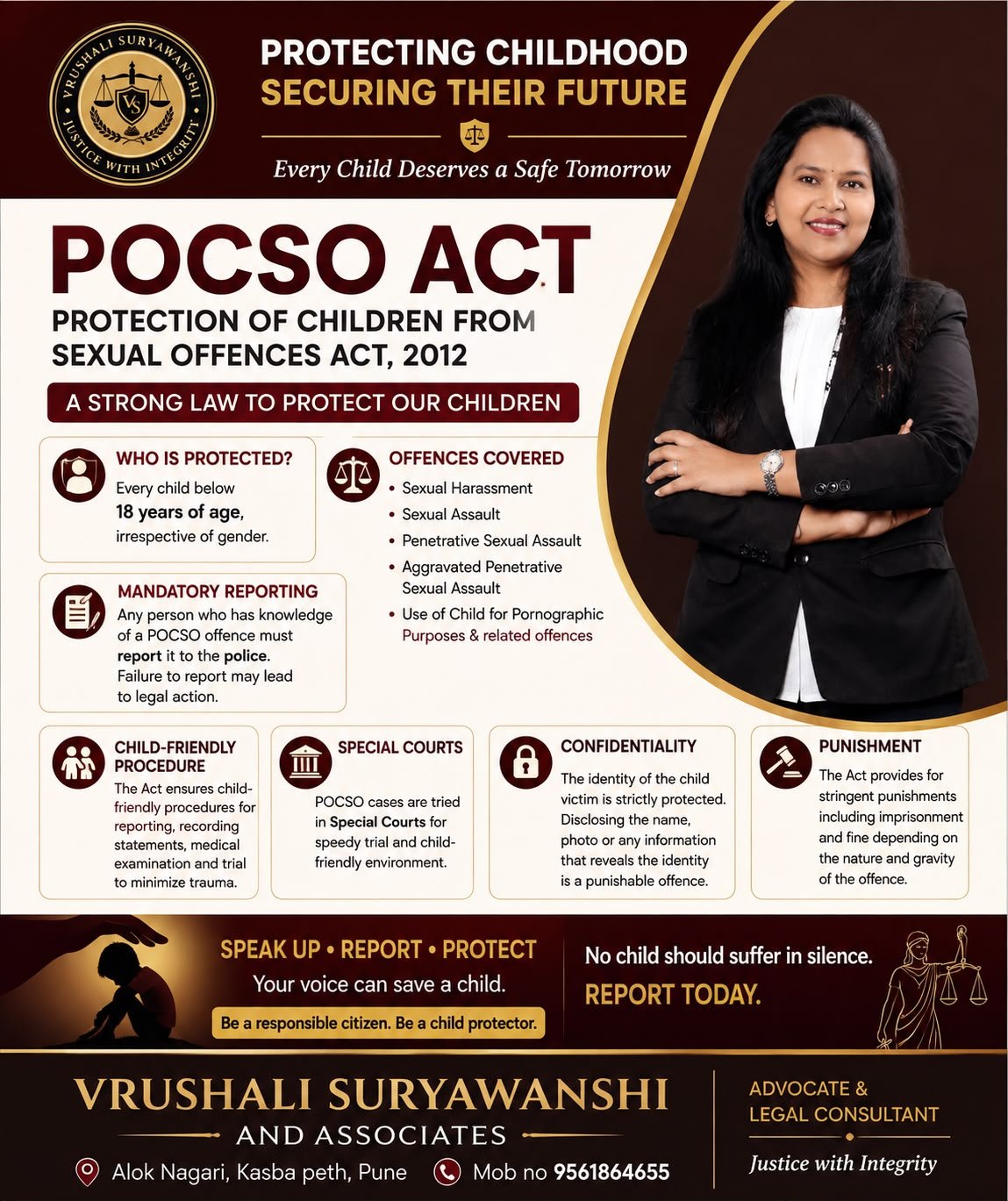
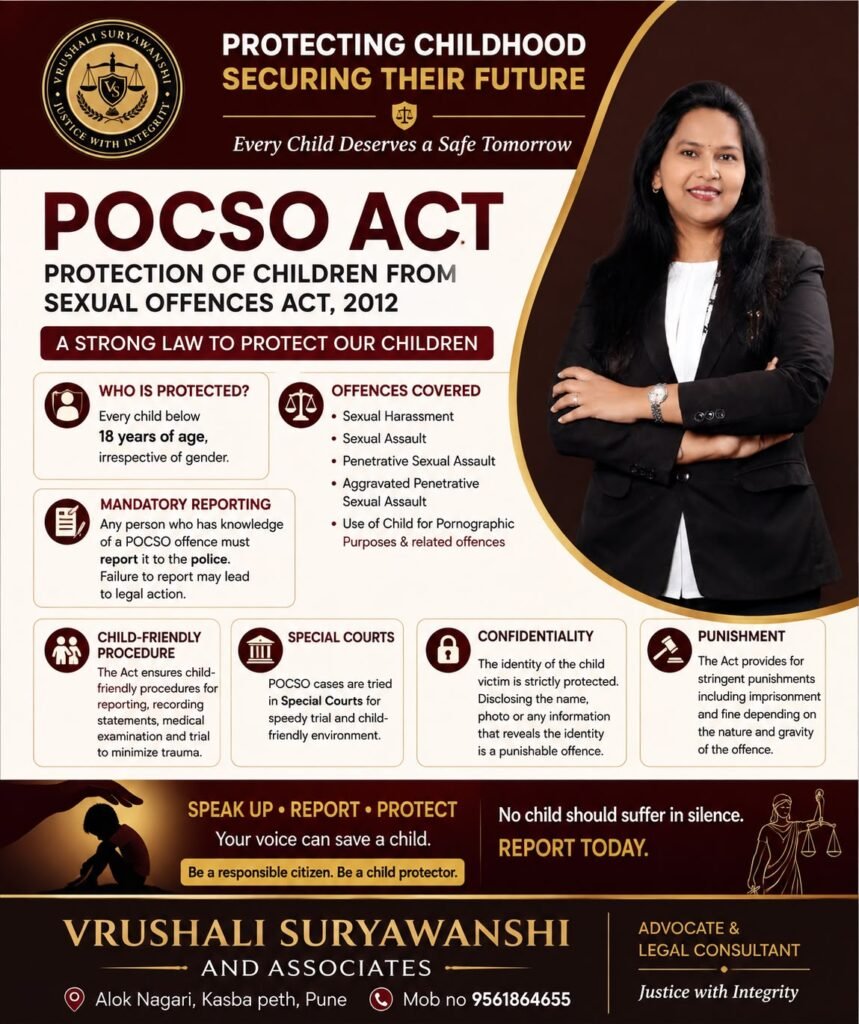
POCSO Act, 2012: Complete Guide to the Protection of Children from Sexual Offences Act
Every child deserves a safe, secure, and dignified childhood. To protect children from sexual abuse, harassment, exploitation, and pornography-related offences, the Government of India enacted the Protection of Children from Sexual Offences (POCSO) Act, 2012.
The POCSO Act provides a comprehensive legal framework for safeguarding children below the age of 18 years. It ensures child-friendly investigation procedures, speedy trials through Special Courts, confidentiality of the victim’s identity, and stringent punishments for offenders.
At Advocate Vrushali Suryawanshi & Associates, we provide legal guidance and representation in criminal law matters, including cases involving offences against children. This guide explains the key provisions of the POCSO Act, who is protected, offences covered, reporting obligations, and the legal process.
What is the POCSO Act, 2012?
The Protection of Children from Sexual Offences (POCSO) Act, 2012 is a special legislation enacted to protect children from sexual offences and to ensure that such cases are handled with sensitivity and urgency.
The Act recognizes that children require special legal protection and establishes procedures designed to minimize trauma during investigation and trial.
Who is Protected Under the POCSO Act?
Under the POCSO Act:
- Every child below 18 years of age is protected.
- Protection is available irrespective of gender.
- The Act applies to boys, girls, and children of all backgrounds.
The law focuses on safeguarding the rights, dignity, and welfare of children.
Offences Covered Under the POCSO Act
The Act covers several offences involving children, including:
Sexual Harassment
Acts involving sexually inappropriate behaviour, gestures, words, or conduct directed at a child.
Sexual Assault
Physical acts of a sexual nature committed against a child.
Penetrative Sexual Assault
Serious offences involving penetrative acts against a child as defined under the Act.
Aggravated Penetrative Sexual Assault
Certain circumstances, such as offences committed by persons in positions of trust or authority, may attract enhanced punishment under the Act.
Use of Children for Pornographic Purposes
The Act also criminalizes the use of children in pornographic material and related offences.
Mandatory Reporting Under the POCSO Act
One of the important features of the POCSO Act is mandatory reporting.
Any person who has knowledge of a POCSO offence is required to report the matter to the appropriate authorities.
Failure to report a POCSO offence may attract legal consequences under the Act.
Prompt reporting helps ensure the safety and protection of children.
Child-Friendly Procedures
The POCSO Act emphasizes procedures that minimize trauma to the child during the legal process.
These include child-sensitive procedures for:
- Reporting the offence
- Recording statements
- Medical examination
- Investigation
- Court proceedings
The objective is to reduce fear, anxiety, and emotional distress.
Special Courts Under the POCSO Act
Cases under the POCSO Act are tried before Special Courts established for the purpose of ensuring speedy trials and a child-friendly judicial process.
These courts are intended to facilitate timely disposal of cases while protecting the interests of the child.
Confidentiality of the Child
The identity of the child victim is protected under the POCSO Act.
Information that may reveal the identity of the child—including the child’s name, photograph, address, or other identifying details—must not be disclosed except in accordance with law.
Maintaining confidentiality helps protect the privacy and dignity of the child.
Punishment Under the POCSO Act
The Act provides stringent punishments for offences against children.
The nature and severity of punishment depend on the specific offence and the facts of the case, and may include imprisonment, fines, or both, as provided by law.
Each case is decided based on the applicable statutory provisions and judicial findings.
Why is the POCSO Act Important?
The POCSO Act plays an important role in:
- Protecting children from sexual abuse.
- Encouraging reporting of offences.
- Ensuring child-friendly investigations.
- Providing speedy trials through Special Courts.
- Protecting the identity and privacy of child victims.
- Deterring offences through stringent legal provisions.
The Act reflects India’s commitment to safeguarding children’s rights and welfare.
What Should You Do if You Suspect a POCSO Offence?
If you become aware of a suspected offence involving a child:
- Ensure the immediate safety of the child.
- Inform the police or the appropriate authorities without delay.
- Avoid disclosing the child’s identity publicly.
- Preserve relevant information or evidence, where possible.
- Seek legal guidance if required.
Timely reporting can play a crucial role in protecting the child and facilitating legal action.
Why Choose Advocate Vrushali Suryawanshi & Associates?
Our firm provides legal assistance in matters relating to:
- Criminal Defence
- POCSO Matters
- Child Protection Laws
- Court Representation
- Bail Applications
- Legal Consultation
- Victim Assistance
- Criminal Litigation
We are committed to providing professional legal services while respecting the dignity and rights of all individuals involved in legal proceedings.
Official Legal Resources
We encourage readers to stay informed through official government legal resources. Whether you wish to understand Indian laws, verify court procedures, check the status of a case, or learn about legal aid services, the following websites provide accurate and up-to-date legal information:
- eCourts Services – Check court case status, hearing dates, and court information.
- India Code – Access official Central Acts, legal provisions, and legislation.
- Bombay High Court – View judgments, cause lists, notifications, and court updates.
- National Legal Services Authority (NALSA) – Learn about legal aid services and legal awareness programmes.
Frequently Asked Questions (FAQs)
1) What is the POCSO Act?
The Protection of Children from Sexual Offences (POCSO) Act, 2012 is a special law enacted to protect children below 18 years of age from sexual offences.
2) Who is protected under the POCSO Act?
Every child below the age of 18 years is protected under the Act, irrespective of gender.
3) What offences are covered under the POCSO Act?
The Act covers offences including sexual harassment, sexual assault, penetrative sexual assault, aggravated penetrative sexual assault, and the use of children for pornographic purposes.
4) Is reporting a POCSO offence mandatory?
Yes. The Act requires persons who have knowledge of certain offences to report them to the appropriate authorities, as provided by law.
5) Why are Special Courts established under the POCSO Act?
Special Courts are designated to facilitate speedy trials and to provide a child-friendly judicial environment for handling POCSO cases.
6) Is the identity of the child kept confidential?
Yes. The identity of the child victim is protected, and disclosure of identifying information is restricted under the law.
7) What punishment is prescribed under the POCSO Act?
The punishment depends on the nature and seriousness of the offence. The Act provides stringent penalties, which may include imprisonment, fines, or both.
8) Why should I consult a lawyer in a POCSO matter?
A lawyer can explain the legal process, protect legal rights, assist with court proceedings, and provide guidance in accordance with applicable laws.
Contact Vrushali Suryawanshi And Associates
If you are looking for trusted legal support in Pune, our team is here to help you with professional legal advice and effective representation.
Vrushali Suryawanshi And Associates | Advocate Vrushali Suryawanshi – Pune
📞 Phone: +91 9022742330 / +91 9561864655
📧 Email: vs.associates.legal@gmail.com
📍 Address: Office No 1, G Wing, Alok Nagari, 1305 Kasba Peth, Near Urdu School, Lunanagar, Shaniwar Wada, Pawale Chowk, Pune 411011, Maharashtra
Book your consultation today and get reliable legal guidance from an experienced lawyer in Pune.