
How Can We Help?
Office No 1, G Wing, Alok Nagari, 1305 Kasba Peth, Near Urdu School, Lunanagar, Shaniwar Wada, Pawale Chowk, Pune 411011, Maharashtra
Trust Deed in India: Complete Guide to Drafting, Registration, Documents & Legal Compliance
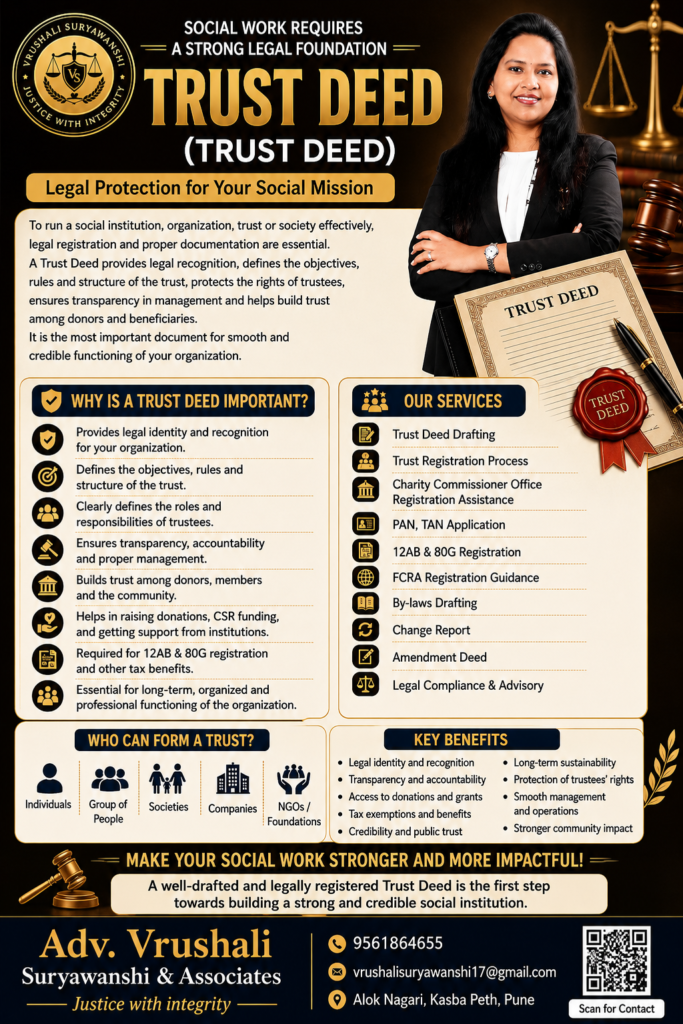
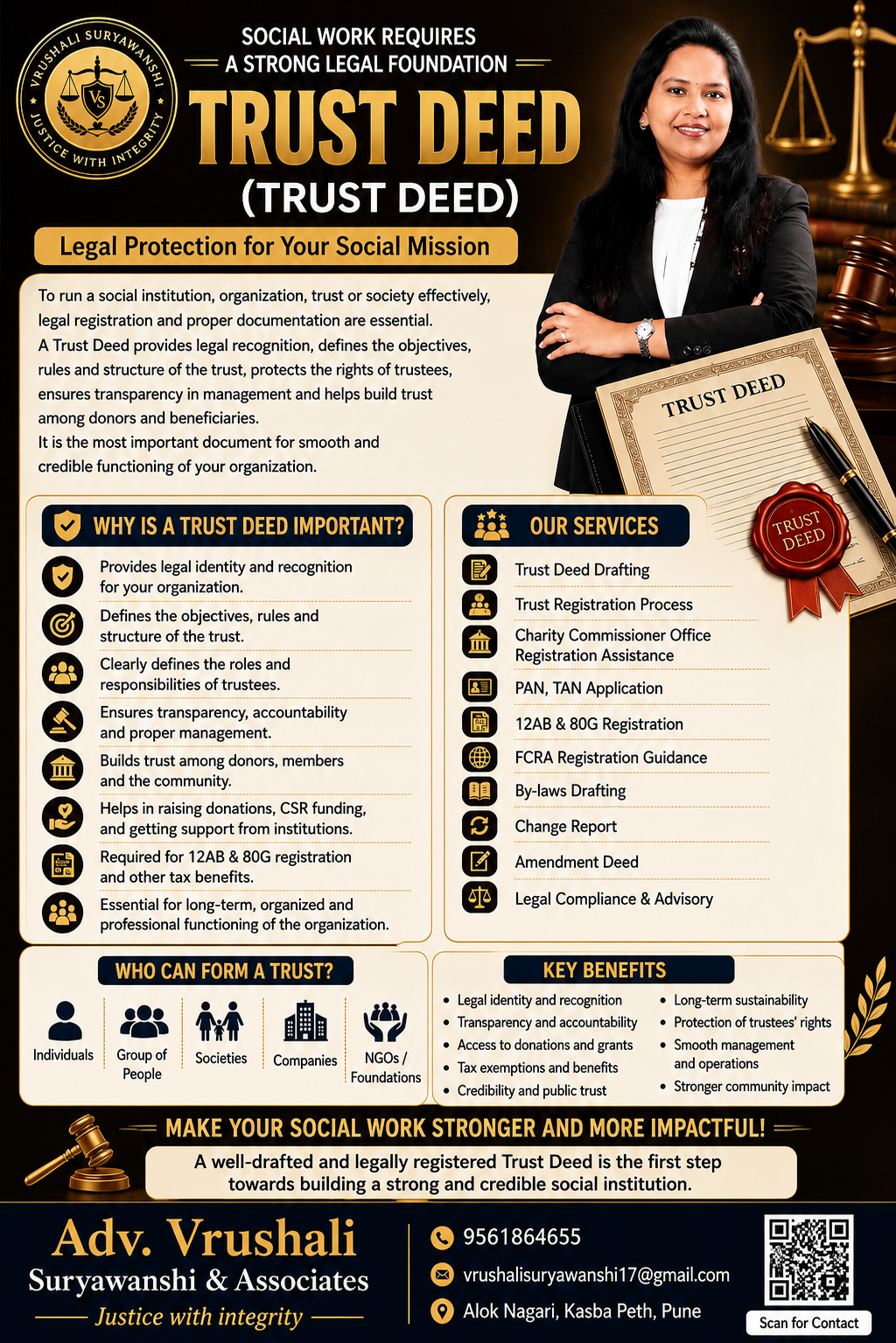
A Trust Deed is an important legal document used to establish and regulate a trust in India. It defines the objectives of the trust, powers and responsibilities of trustees, rules for managing trust property, and the manner in which the trust will carry out its activities.
A properly drafted Trust Deed provides a strong legal foundation for charitable, educational, social welfare, religious and other public-benefit activities.
At Advocate Vrushali Suryawanshi & Associates, we provide legal assistance for Trust Deed drafting, trust registration and related legal compliance in Pune.
Legal Note: Requirements can vary depending on the type of trust, state law, objectives and proposed activities. Specific tax registrations such as 12AB and 80G and permissions such as FCRA registration are separate legal processes and should not be treated as automatic consequences of trust registration.
What is a Trust Deed?
A Trust Deed is a legal instrument through which the settlor establishes a trust and specifies its objectives, trustees, powers, responsibilities and rules for administration.
A Trust Deed generally contains important information such as:
- Name of the trust
- Registered office address
- Name and details of the settlor
- Names and details of trustees
- Objects and activities of the trust
- Powers and duties of trustees
- Rules regarding meetings and decision-making
- Management of trust property and funds
- Bank account and financial management provisions
- Appointment and resignation of trustees
- Amendment provisions
- Dissolution or winding-up provisions
- Rules relating to application of trust funds
A carefully drafted Trust Deed can help provide clarity and reduce the possibility of future disputes.
Why is a Trust Deed Important?
A Trust Deed serves as the legal foundation for the functioning of a trust.
It can help to:
1. Establish the Legal Identity and Objectives of the Trust
The Trust Deed records the purpose and objectives for which the trust is established.
2. Define the Powers and Responsibilities of Trustees
It establishes the duties, powers and responsibilities of trustees and helps ensure proper administration.
3. Clarify the Rules of Management
The deed can specify how decisions will be made, how meetings will be conducted and how the trust’s affairs will be managed.
4. Help Prevent Future Disputes
Clearly documented rights, responsibilities and procedures can reduce misunderstandings between trustees and other stakeholders.
5. Facilitate Financial and Property Management
The deed can contain provisions relating to bank accounts, donations, trust property, investments and financial administration.
6. Support Long-Term Administration
A properly drafted deed can provide a framework for the continued functioning of the trust even when trustees change.
Who Can Establish a Trust?
Depending on the applicable legal framework and nature of the trust, a trust may generally be established by:
- An individual
- A group of individuals
- A family
- An organization or institution, where legally permissible
The exact structure and requirements depend on the type of trust and applicable law.
For charitable and public-benefit purposes, the Trust Deed should clearly define the intended charitable or social objectives.
Common Objectives of a Charitable Trust
A charitable trust may be established for objectives such as:
- Education and training
- Healthcare and medical assistance
- Women and child welfare
- Support for senior citizens
- Assistance to economically weaker sections
- Environmental protection
- Poverty relief
- Religious or charitable activities, where applicable
- Support for persons with disabilities
- Social welfare activities
- Promotion of community development
- Other lawful public-benefit activities
The objectives should be drafted carefully because they may have implications for subsequent registrations, tax benefits and regulatory compliance.
Trust Deed Registration Process
The general process for establishing and registering a trust may involve the following steps:
Step 1: Decide the Objectives of the Trust
The proposed activities and charitable or other lawful objectives should first be identified.
Step 2: Select the Name of the Trust
A suitable name should be selected while considering applicable naming and registration requirements.
Step 3: Identify the Settlor and Trustees
Details of the settlor and proposed trustees should be collected.
Step 4: Draft the Trust Deed
The Trust Deed should clearly specify:
- Trust objectives
- Trustee details
- Powers and duties
- Administration rules
- Financial provisions
- Trust property
- Amendment procedures
- Dissolution provisions
Step 5: Execute the Trust Deed
The deed is executed by the relevant parties in accordance with applicable legal and stamp requirements.
Step 6: Registration
The Trust Deed is submitted to the appropriate authority/office along with the prescribed documents and applicable fees.
Step 7: Obtain Relevant Registrations and Compliance Approvals
Depending on the trust’s activities, additional registrations or approvals may be required, such as:
- PAN
- TAN, where applicable
- Income-tax registrations
- 12AB registration
- 80G approval
- FCRA registration or prior permission, where applicable
These are separate regulatory requirements and their eligibility should be assessed based on the trust’s circumstances.
Documents Required for Trust Deed Registration
Commonly required documents may include:
- Identity proof of settlor
- Address proof of settlor
- Identity proof of trustees
- Address proof of trustees
- Passport-size photographs
- Address proof of the registered office
- Ownership proof or NOC for the premises, where applicable
- Details of proposed trust property
- Draft Trust Deed
- Information regarding the objectives of the trust
- Other documents prescribed by the concerned authority
The exact documentation may vary depending on the nature of the trust and applicable state requirements.
Services Related to Trust Deed
At Advocate Vrushali Suryawanshi & Associates, legal assistance may include:
- Trust Deed drafting
- Trust registration guidance
- Charity Commissioner-related procedures
- PAN and TAN application assistance
- 12AB registration guidance
- 80G registration guidance
- FCRA registration guidance
- Trust rules and by-laws drafting
- Change Report assistance
- Amendment Deed drafting
- Legal compliance guidance
- Legal consultation relating to trust administration
Who Can Benefit from a Trust?
A trust structure may be considered by individuals or groups intending to undertake lawful activities for purposes such as:
- Social welfare
- Education
- Healthcare
- Women and child welfare
- Environmental protection
- Religious activities
- Community development
- Support for disadvantaged persons
- Other charitable or public-benefit activities
The appropriate legal structure should be selected based on the objectives, activities and regulatory requirements of the organization.
Important Legal Considerations
Before establishing a trust, it is advisable to carefully consider:
Clearly Define the Objectives
The objectives should be specific, lawful and consistent with the intended activities.
Draft Trustee Powers Carefully
The Trust Deed should clearly establish the powers and responsibilities of trustees.
Maintain Proper Records
Financial records, meeting records, resolutions and other required documents should be properly maintained
Understand Tax Compliance
Trust registration and income-tax-related registrations are separate matters. Eligibility for tax exemptions or benefits depends on applicable provisions and compliance requirements.
Consider Foreign Contributions Separately
If a trust intends to receive foreign contributions, applicable FCRA requirements must be examined separately.
Update the Deed When Necessary
Changes in trustees, objectives or other important matters may require appropriate legal procedures and filings.
Benefits of a Properly Drafted Trust Deed
A well-drafted Trust Deed can provide:
- Clear objectives and purpose
- Defined trustee responsibilities
- Better administrative clarity
- Reduced possibility of disputes
- Proper management framework
- Greater transparency
- Better long-term governance
- A foundation for subsequent legal and regulatory compliance
Why Choose Advocate Vrushali Suryawanshi & Associates?
Establishing and managing a trust involves documentation, registration procedures and continuing legal compliance.
Advocate Vrushali Suryawanshi & Associates, Pune, provides legal assistance relating to Trust Deed drafting, registration and associated documentation.
Our approach focuses on:
- Proper legal documentation
- Clear drafting
- Compliance-oriented guidance
- Assistance with registration procedures
- Professional legal consultation
- Long-term legal support
Official Legal Resources
We encourage readers to stay informed through official government legal resources. Whether you wish to understand Indian laws, verify court procedures, check the status of a case, or learn about legal aid services, the following websites provide accurate and up-to-date legal information:
- eCourts Services – Check court case status, hearing dates, and court information.
- India Code – Access official Central Acts, legal provisions, and legislation.
- Bombay High Court – View judgments, cause lists, notifications, and court updates.
- National Legal Services Authority (NALSA) – Learn about legal aid services and legal awareness programmes.
Frequently Asked Questions (FAQs)
1) What is a Trust Deed?
A Trust Deed is a legal document that establishes a trust and specifies its objectives, trustees, powers, responsibilities and rules for administration.
2) Why is a Trust Deed required?
A Trust Deed provides the legal framework for establishing and managing a trust. It records the trust’s objectives, trustees and administrative rules.
3) Who can create a Trust Deed?
An individual or group of individuals may establish a trust, subject to applicable law and the nature of the proposed trust.
4) What documents are required for Trust Deed registration?
Common documents include identity and address proofs of the settlor and trustees, photographs, registered-office documents, the draft Trust Deed and details of the proposed trust property. Additional documents may be required depending on the circumstances.
5) Is Trust Deed registration mandatory?
The requirements depend on the type of trust, applicable state law and the nature of the trust property and activities. Legal advice should be obtained before establishing the trust.
6) What are the main objectives of a charitable trust?
Charitable trusts may undertake activities relating to education, healthcare, poverty relief, social welfare, environmental protection, women and child welfare and other lawful public-benefit purposes.
7) What is 12AB registration?
12AB registration is an income-tax-related registration relevant to eligible charitable or religious institutions seeking tax exemption under applicable provisions. It is separate from the basic creation or registration of a trust.
8) What is 80G registration?
80G approval may allow eligible donors to claim a deduction for qualifying donations, subject to the applicable Income-tax Act provisions and conditions. It is separate from Trust Deed registration.
9) Does every trust need FCRA registration?
No. FCRA requirements become relevant where an organization seeks to receive or utilize foreign contributions covered by the Foreign Contribution (Regulation) Act. Eligibility and compliance requirements should be examined separately.
10) Can the Trust Deed be amended?
Depending on the terms of the deed and applicable law, amendments may be possible through the prescribed legal procedure. Certain changes may also require filing or approval with the relevant authority.
11) Can trustees be changed after registration?
Changes in trustees may be possible subject to the provisions of the Trust Deed and applicable law. Appropriate documentation and filings may be required.
12) Can a Trust Deed help prevent disputes?
A clearly drafted deed can reduce uncertainty by defining trustee powers, responsibilities, decision-making procedures and administrative rules. However, it cannot completely eliminate the possibility of disputes.
13) Should I consult a lawyer before creating a Trust Deed?
Yes. Professional legal guidance can help ensure that the objectives, trustee powers, administrative provisions and compliance requirements are appropriately addressed.
Contact Vrushali Suryawanshi And Associates
If you are looking for trusted legal support in Pune, our team is here to help you with professional legal advice and effective representation.
Vrushali Suryawanshi And Associates | Advocate Vrushali Suryawanshi – Pune
📞 Phone: +91 9022742330 / +91 9561864655
📧 Email: vs.associates.legal@gmail.com
📍 Address: Office No 1, G Wing, Alok Nagari, 1305 Kasba Peth, Near Urdu School, Lunanagar, Shaniwar Wada, Pawale Chowk, Pune 411011, Maharashtra
Book your consultation today and get reliable legal guidance from an experienced lawyer in Pune.