

How Can We Help?
Office No 1, G Wing, Alok Nagari, 1305 Kasba Peth, Near Urdu School, Lunanagar, Shaniwar Wada, Pawale Chowk, Pune 411011, Maharashtra
Child Custody in India: Legal Rights, Court Process & Important Factors
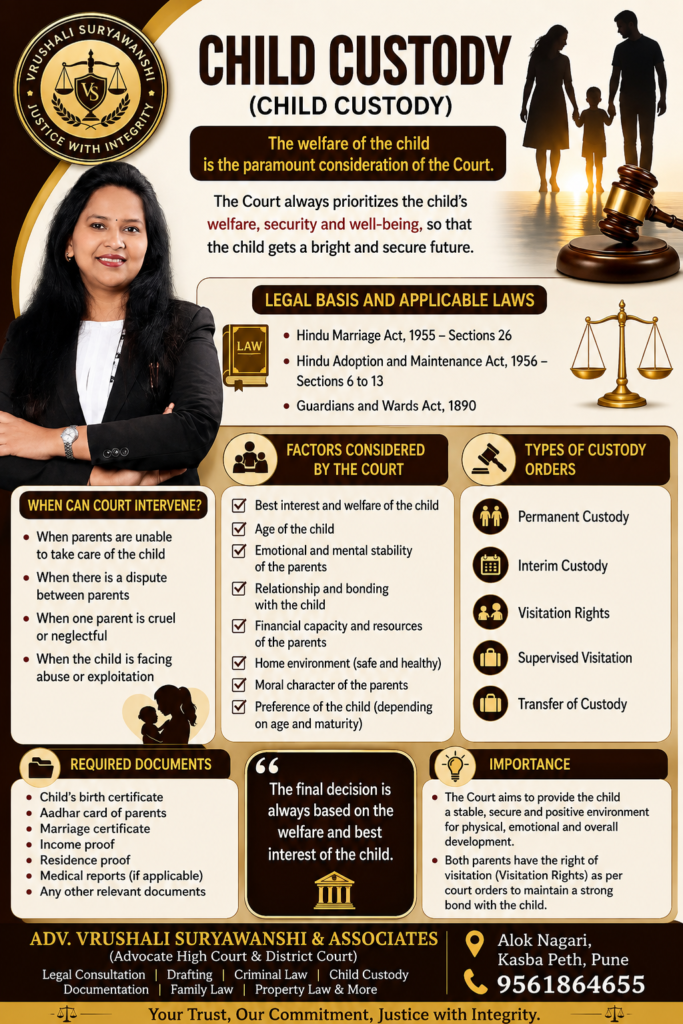
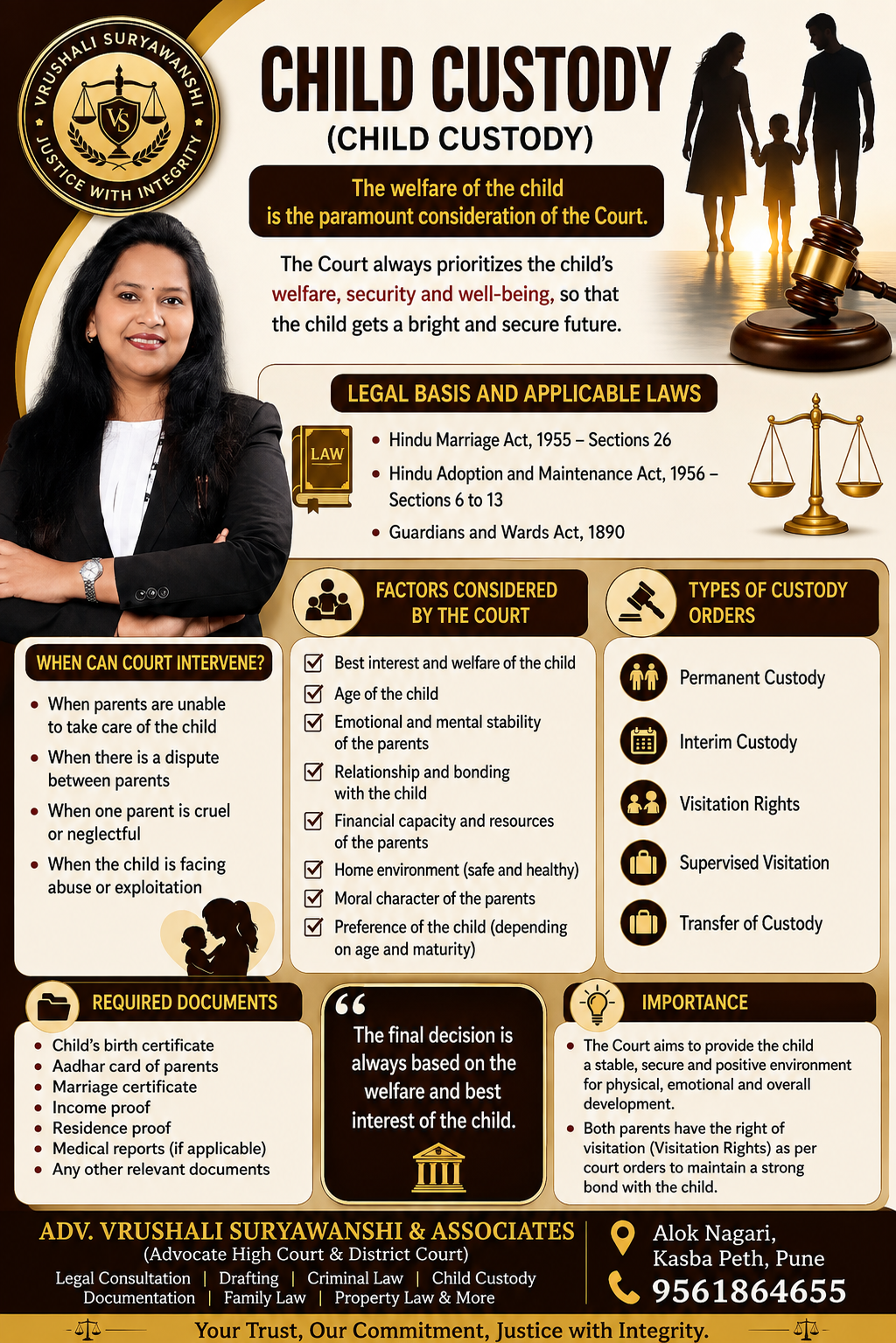
When parents separate or divorce, one of the most important legal issues is Child Custody in India. The primary concern of every court is not whether the mother or father should get custody, but what is in the best interest of the child.
Indian courts carefully evaluate the child’s welfare, emotional well-being, education, safety, and overall development before deciding custody matters.
At Vrushali Suryawanshi & Associates, we provide legal assistance in child custody cases before Family Courts in Pune and help parents protect the rights and future of their children.
What is Child Custody?
Child Custody in India refers to the legal right granted by the court to a parent or guardian to care for, raise, and make important decisions regarding a child’s upbringing.
The objective of child custody laws is to ensure that the child grows in a safe, stable, and supportive environment.
The court always considers the best interests of the child as its highest priority.
Laws Governing Child Custody in India
Several laws regulate child custody depending on the personal law applicable to the parties.
Hindu Marriage Act, 1955
Section 26 empowers courts to pass orders regarding custody, maintenance, and education of children.
Hindu Minority and Guardianship Act, 1956
Sections 6 and 13 deal with guardianship and emphasize that the welfare of the child is paramount.
Guardians and Wards Act, 1890
This Act applies in cases where personal laws do not specifically govern custody or guardianship matters.
When Can a Child Custody Case Be Filed?
A parent or guardian may approach the Family Court in situations such as:
- During divorce proceedings
- Judicial separation
- Parents living separately
- Denial of access to the child
- Disputes regarding custody
- Child welfare concerns
- Modification of an existing custody order
Factors Considered by the Court
Before granting custody, the court evaluates several important factors.
Best Interest of the Child
This remains the most important consideration.
Age of the Child
Young children, especially infants, are often placed with the mother unless circumstances suggest otherwise.
Financial Stability
The court considers whether the parent can provide proper education, healthcare, and financial support.
Emotional and Mental Well-being
The emotional bond between the parent and child is carefully evaluated.
Safe Environment
The child should have a secure, healthy, and supportive environment.
Child’s Preference
If the child is mature enough, the court may consider their wishes.
Character and Conduct of Parents
The court examines the conduct and overall suitability of each parent.
Types of Child Custody
Permanent Custody
The court grants long-term custody to one parent based on the child’s welfare.
Interim Custody
Temporary custody granted until the final decision.
Joint Custody
Both parents share responsibility for raising the child.
Physical Custody
The child resides primarily with one parent.
Legal Custody
The right to make important decisions regarding education, healthcare, and welfare.
Visitation Rights
The parent without custody is generally granted visitation rights to maintain a relationship with the child.
Documents Required for Child Custody Cases
Generally, the following documents are required:
- Birth Certificate of the child
- Marriage Certificate (if applicable)
- Aadhaar Card or Identity Proof
- Address Proof
- School Records
- Medical Records
- Income Proof
- Photographs
- Previous Court Orders (if any)
- Other supporting documents
Can Custody Orders Be Changed?
Yes.
If circumstances significantly change, either parent may approach the court to modify an existing custody order.
Examples include:
- Change in financial condition
- Relocation
- Child abuse or neglect
- Change in the child’s educational needs
- Health concerns
- Any circumstance affecting the child’s welfare
Important Points to Remember
- Child welfare is always the highest priority.
- Custody decisions depend on the facts of each case.
- Mothers are not automatically granted custody.
- Fathers also have equal legal rights to seek custody.
- Visitation rights are generally granted even if custody is awarded to one parent.
- Courts encourage arrangements that promote the child’s overall development.
Why Choose Advocate Vrushali Suryawanshi & Associates?
Our legal team provides professional assistance in:
- Child Custody Cases
- Guardianship Matters
- Divorce Proceedings
- Family Court Litigation
- Visitation Rights
- Child Maintenance
- Family Law Consultation
We understand the emotional nature of custody disputes and work to protect both your legal rights and your child’s future.
Official Legal Resources
We encourage readers to stay informed through official government legal resources. Whether you wish to understand Indian laws, verify court procedures, check the status of a case, or learn about legal aid services, the following websites provide accurate and up-to-date legal information:
- eCourts Services – Check court case status, hearing dates, and court information.
- India Code – Access official Central Acts, legal provisions, and legislation.
- Bombay High Court – View judgments, cause lists, notifications, and court updates.
- National Legal Services Authority (NALSA) – Learn about legal aid services and legal awareness programmes.
Frequently Asked Questions (FAQs)
1) What is child custody?
Child custody is the legal right granted by the court to a parent or guardian to care for and raise a child.
2) Which law governs child custody in India?
Child custody is governed by the Hindu Marriage Act, 1955, the Hindu Minority and Guardianship Act, 1956, and the Guardians and Wards Act, 1890, depending on the circumstances.
3) Who gets custody after divorce?
The court decides custody based on the best interests of the child rather than automatically favoring either parent.
4) Can fathers get child custody?
Yes. Fathers have equal legal rights to seek custody if it serves the child’s welfare.
5) Can custody orders be modified?
Yes. Either parent may request modification if there is a significant change in circumstances affecting the child’s welfare.
6) What documents are required for a custody case?
Common documents include the child’s birth certificate, identity proof, address proof, school records, medical records, income proof, and other supporting documents.
7) What are visitation rights?
Visitation rights allow the non-custodial parent to spend time with the child as directed by the court.
8) How long does a child custody case take?
The duration depends on the complexity of the case, evidence, court proceedings, and the Family Court’s schedule.
Contact Vrushali Suryawanshi And Associates
If you are looking for trusted legal support in Pune, our team is here to help you with professional legal advice and effective representation.
Vrushali Suryawanshi And Associates | Advocate Vrushali Suryawanshi – Pune
📞 Phone: +91 9022742330 / +91 9561864655
📧 Email: vs.associates.legal@gmail.com
📍 Address: Office No 1, G Wing, Alok Nagari, 1305 Kasba Peth, Near Urdu School, Lunanagar, Shaniwar Wada, Pawale Chowk, Pune 411011, Maharashtra
Book your consultation today and get reliable legal guidance from an experienced lawyer in Pune.