

How Can We Help?
Office No 1, G Wing, Alok Nagari, 1305 Kasba Peth, Near Urdu School, Lunanagar, Shaniwar Wada, Pawale Chowk, Pune 411011, Maharashtra
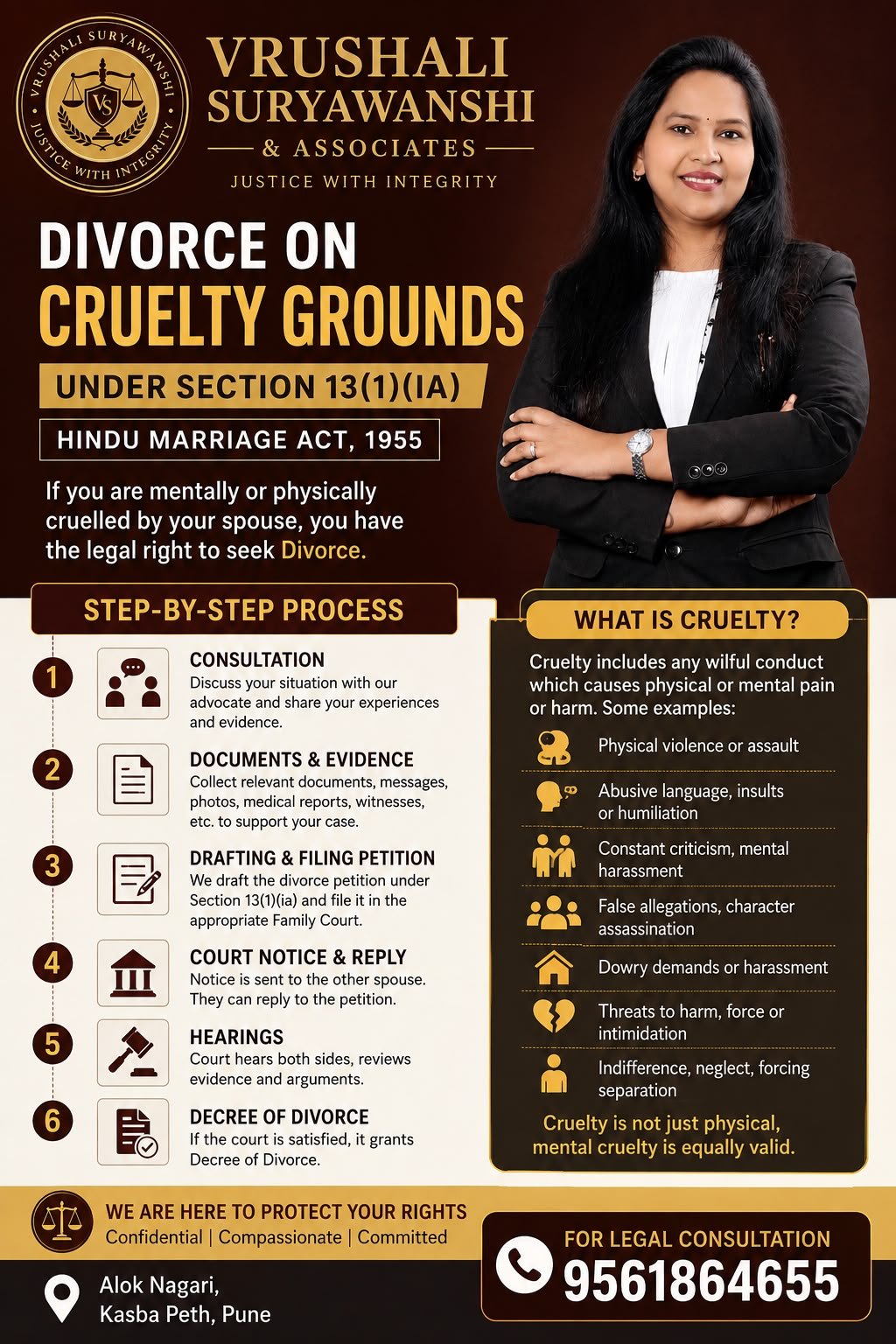
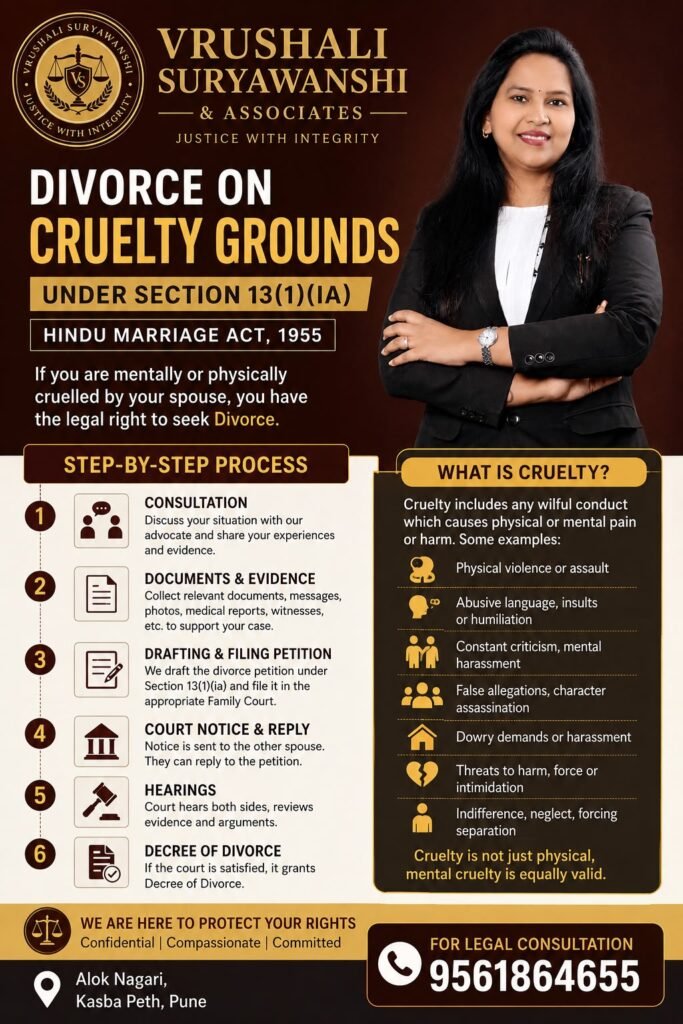
Divorce on Cruelty Grounds Under Section 13(1)(ia) of the Hindu Marriage Act, 1955 – Complete Legal Guide
Marriage is built on trust, respect, and mutual understanding. However, when one spouse subjects the other to physical or mental cruelty, the law provides a legal remedy through Divorce on Cruelty Grounds under Section 13(1)(ia) of the Hindu Marriage Act, 1955.
Cruelty is one of the most common grounds for divorce in India. It is not limited to physical violence—mental cruelty, emotional abuse, humiliation, false allegations, and continuous harassment may also constitute cruelty under Indian law.
At Advocate Vrushali Suryawanshi & Associates, we assist clients in divorce proceedings involving cruelty by providing professional legal advice, drafting petitions, collecting evidence, and representing clients before the Family Court in Pune.
What is Divorce on Cruelty Grounds Under Section 13(1)(ia)?
Divorce on Cruelty Grounds Under Section 13(1)(ia) allows a spouse to seek dissolution of marriage if they have been subjected to physical or mental cruelty by the other spouse.
Section 13(1)(ia) of the Hindu Marriage Act, 1955 recognizes that continued cruelty makes it impossible for spouses to live together peacefully. If the court is satisfied that cruelty has been established through evidence, it may grant a decree of divorce.
What is Cruelty?
Cruelty refers to any deliberate conduct that causes physical injury, emotional suffering, mental trauma, or serious hardship to the other spouse.
Indian courts recognize both physical cruelty and mental cruelty.
Examples include:
- Physical violence or assault
- Abusive language and repeated insults
- Mental harassment and constant criticism
- False criminal allegations against the spouse
- Character assassination
- Dowry-related harassment or unlawful demands
- Threats, intimidation, or coercion
- Emotional neglect and intentional abandonment
- Forcing separation from family members
- Repeated humiliation in public or before relatives
Mental cruelty can be as serious as physical cruelty and may independently be sufficient to seek divorce.
Who Can File for Divorce on Cruelty Grounds?
A husband or wife governed by the Hindu Marriage Act may file a divorce petition if they have suffered cruelty from their spouse.
Each case is decided based on its own facts and evidence presented before the Family Court.
Step-by-Step Process for Divorce on Cruelty Grounds
Step 1: Legal Consultation
Consult an experienced family lawyer to understand your legal rights and evaluate whether the facts of your case constitute cruelty under the law.
During the consultation, discuss:
- Incidents of cruelty
- Timeline of events
- Available evidence
- Possible legal remedies
Step 2: Collect Documents and Evidence
Evidence plays a crucial role in proving cruelty.
Common evidence includes:
- Medical reports
- Photographs of injuries
- Audio or video recordings (where legally admissible)
- WhatsApp chats, emails, and messages
- Police complaints
- Witness statements
- Financial records
- Any other relevant documents
Proper documentation strengthens the case before the court.
Step 3: Drafting and Filing the Divorce Petition
After reviewing the facts, your advocate prepares the divorce petition under Section 13(1)(ia) of the Hindu Marriage Act, 1955.
The petition generally contains:
- Marriage details
- Facts constituting cruelty
- Supporting evidence
- Relief sought from the court
The petition is then filed before the appropriate Family Court.
Step 4: Court Notice and Reply
After the petition is admitted, the court issues notice to the other spouse.
The respondent is given an opportunity to file a written reply and present their defence.
Step 5: Court Hearings
The Family Court hears both parties.
The proceedings may include:
- Filing evidence
- Examination of witnesses
- Cross-examination
- Legal arguments by both advocates
The court evaluates all facts and evidence before arriving at its decision.
Step 6: Decree of Divorce
If the court is satisfied that cruelty has been proved, it may grant a decree dissolving the marriage.
The divorce becomes legally effective from the date of the decree.
Documents Commonly Required
Depending on the facts of the case, the following documents may be required:
- Marriage Certificate
- Aadhaar Card or Passport
- Address Proof
- Wedding photographs
- Medical reports
- Police complaints (if any)
- WhatsApp chats, emails, or messages
- Audio or video evidence (where legally admissible)
- Witness details
- Income documents
- Photographs
- Other supporting documents
What Constitutes Mental Cruelty?
Mental cruelty may include:
- Constant humiliation
- Emotional abuse
- Repeated insults
- Character assassination
- False allegations
- Public embarrassment
- Continuous neglect
- Threats of false criminal cases
- Refusal to cohabit without reasonable cause
- Persistent abusive behaviour
Courts examine the overall conduct of the parties rather than isolated incidents.
Important Legal Considerations
Before filing a divorce petition:
- Each case depends on its unique facts and evidence.
- Mere disagreements or ordinary marital differences may not amount to legal cruelty.
- Documentary and witness evidence significantly strengthen the case.
- The burden of proof lies on the spouse alleging cruelty.
- Professional legal advice should be obtained before initiating proceedings.
Confidentiality of the Child
The identity of the child victim is protected under the POCSO Act.
Information that may reveal the identity of the child—including the child’s name, photograph, address, or other identifying details—must not be disclosed except in accordance with law.
Maintaining confidentiality helps protect the privacy and dignity of the child.
Why Choose Advocate Vrushali Suryawanshi & Associates?
Our firm provides comprehensive legal assistance in family law matters, including:
- Divorce on Cruelty Grounds
- Mutual Consent Divorce
- Contested Divorce
- Domestic Violence Matters
- Child Custody
- Maintenance & Alimony
- Judicial Separation
- Family Court Representation
- Legal Documentation
- Legal Consultation
We are committed to protecting our clients’ legal rights while providing compassionate and professional legal support.
Official Legal Resources
We encourage readers to stay informed through official government legal resources. Whether you wish to understand Indian laws, verify court procedures, check the status of a case, or learn about legal aid services, the following websites provide accurate and up-to-date legal information:
- eCourts Services – Check court case status, hearing dates, and court information.
- India Code – Access official Central Acts, legal provisions, and legislation.
- Bombay High Court – View judgments, cause lists, notifications, and court updates.
- National Legal Services Authority (NALSA) – Learn about legal aid services and legal awareness programmes.
Frequently Asked Questions (FAQs)
1) What is Divorce on Cruelty Grounds?
It is a legal remedy available under Section 13(1)(ia) of the Hindu Marriage Act, 1955, allowing a spouse to seek divorce if subjected to physical or mental cruelty.
2) Does mental cruelty qualify for divorce?
Yes. Indian courts recognize both physical and mental cruelty as valid grounds for divorce, depending on the facts and evidence presented.
3) What evidence is required to prove cruelty?
Evidence may include medical reports, police complaints, witness testimony, photographs, electronic communications, financial records, and other relevant documents.
4) Can verbal abuse amount to cruelty?
Repeated verbal abuse, humiliation, threats, and emotional harassment may constitute mental cruelty, depending on the circumstances.
5) Is physical violence necessary to obtain a divorce on cruelty grounds?
No. Physical violence is not essential. Mental cruelty alone may be sufficient if supported by credible evidence.
6) Which court hears divorce cases based on cruelty?
Such petitions are generally filed before the appropriate Family Court having jurisdiction.
7) How long does a cruelty divorce case take?
The duration depends on the complexity of the case, evidence, court procedures, and case pendency. Timelines vary from case to case.
8) Why should I consult a divorce lawyer before filing a case?
An experienced lawyer can evaluate your case, prepare the petition, collect relevant evidence, represent you in court, and ensure compliance with legal procedures.
Contact Vrushali Suryawanshi And Associates
If you are looking for trusted legal support in Pune, our team is here to help you with professional legal advice and effective representation.
Vrushali Suryawanshi And Associates | Advocate Vrushali Suryawanshi – Pune
📞 Phone: +91 9022742330 / +91 9561864655
📧 Email: vs.associates.legal@gmail.com
📍 Address: Office No 1, G Wing, Alok Nagari, 1305 Kasba Peth, Near Urdu School, Lunanagar, Shaniwar Wada, Pawale Chowk, Pune 411011, Maharashtra
Book your consultation today and get reliable legal guidance from an experienced lawyer in Pune.