
How Can We Help?
Office No 1, G Wing, Alok Nagari, 1305 Kasba Peth, Near Urdu School, Lunanagar, Shaniwar Wada, Pawale Chowk, Pune 411011, Maharashtra
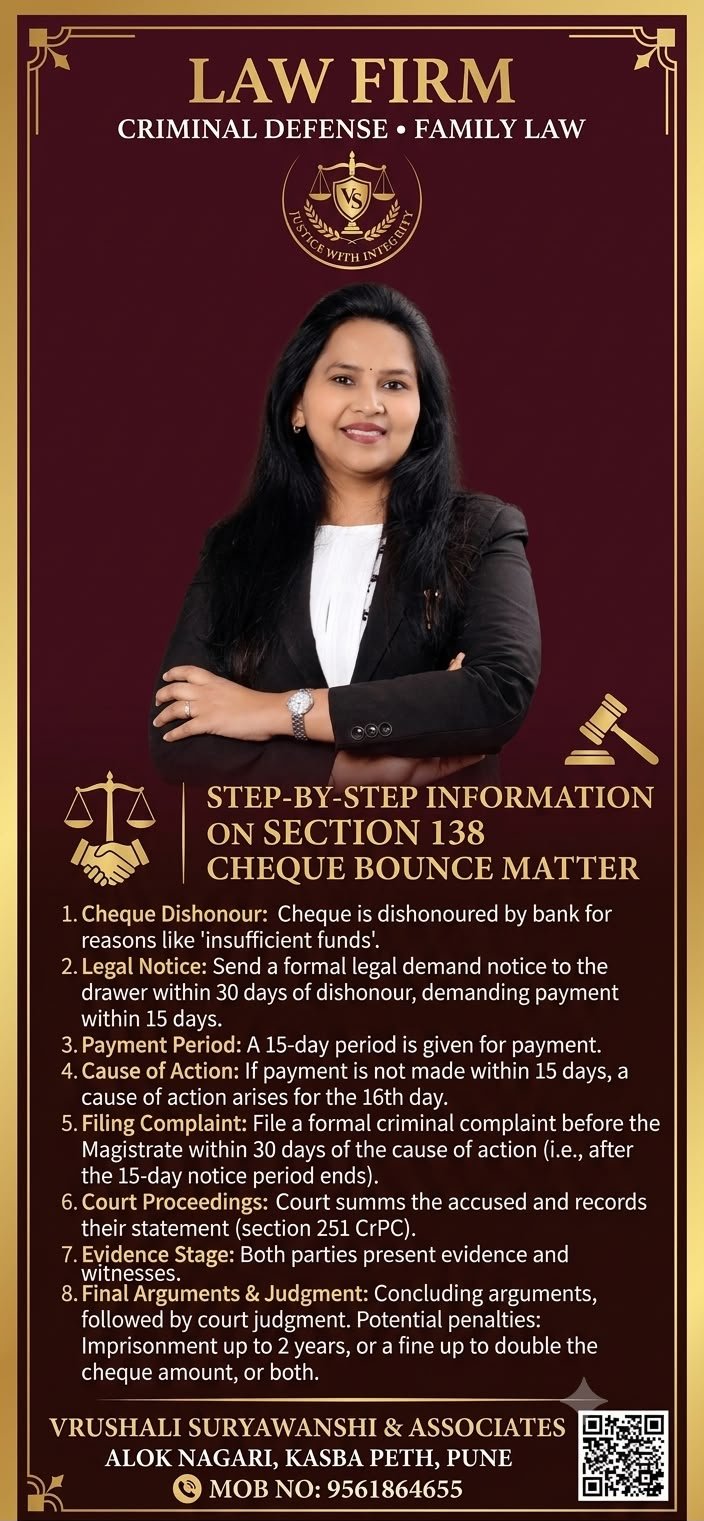
Section 138 Cheque Bounce Case: Step-by-Step Legal Process Under the Negotiable Instruments Act
A cheque is a legally recognized mode of payment in India. However, when a cheque is returned unpaid due to reasons such as insufficient funds or other legally recognized grounds, it may result in legal consequences under Section 138 of the Negotiable Instruments Act, 1881.
A cheque bounce case is not only a financial issue but may also lead to criminal proceedings if the statutory requirements are fulfilled. Understanding the legal process helps both cheque holders and cheque issuers protect their rights and comply with the law.
At Advocate Vrushali Suryawanshi & Associates, we provide legal assistance in cheque bounce matters, including legal notices, complaint drafting, court representation, settlement negotiations, and recovery proceedings in Pune.
This guide explains the complete legal process involved in a cheque bounce case under Section 138.
What is Section 138 of the Negotiable Instruments Act?
Section 138 of the Negotiable Instruments Act, 1881 deals with the dishonour of cheques due to insufficient funds or when the amount exceeds the arrangement made with the bank.
If the statutory conditions are fulfilled, the cheque holder may initiate legal proceedings against the drawer of the cheque.
The objective of this provision is to promote trust and reliability in commercial transactions involving cheques.
Common Reasons for Cheque Bounce
A cheque may be dishonoured for several reasons, including:
- Insufficient funds in the account
- Account closed
- Payment stopped by the drawer
- Signature mismatch
- Incorrect date
- Alterations in the cheque
- Exceeds arrangement with the bank
- Stale cheque
- Technical defects
Not every dishonour automatically attracts liability under Section 138. The facts of each case determine whether legal action can be initiated.
Step-by-Step Legal Process in a Section 138 Cheque Bounce Case
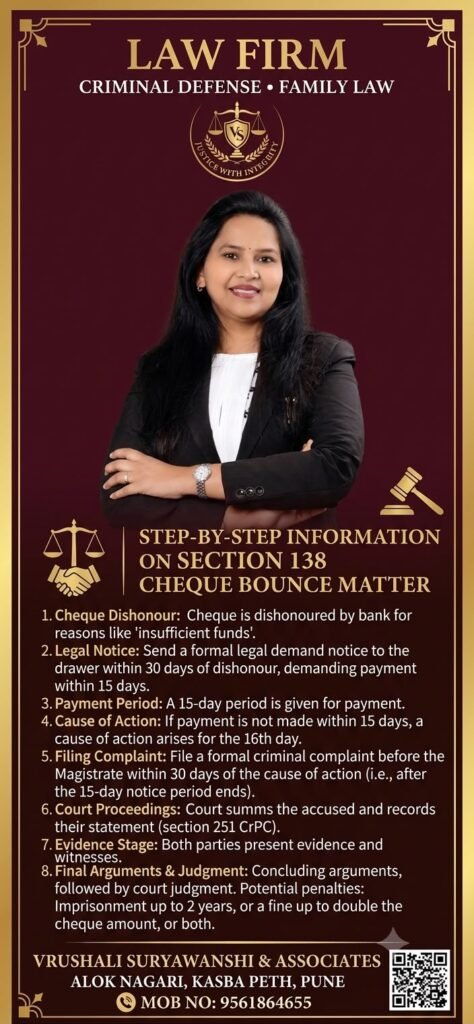
Step 1: Dishonour of the Cheque
The process begins when the bank returns the cheque unpaid along with a Cheque Return Memo stating the reason for dishonour.
Common reasons include:
- Insufficient funds
- Payment stopped
- Account closed
- Exceeds arrangement
The return memo serves as an important document in subsequent legal proceedings.
Step 2: Sending a Legal Notice
After receiving the cheque return memo, the payee is generally required to send a legal demand notice to the drawer within the time prescribed under the Negotiable Instruments Act.
The notice usually contains:
- Details of the cheque
- Amount payable
- Date of dishonour
- Demand for payment
- Time allowed under law
A properly drafted legal notice is a critical step in the process.
Step 3: Waiting Period for Payment
Upon receiving the legal notice, the drawer is given the statutory period to make payment.
If payment is made within the prescribed time, the dispute may conclude without further legal proceedings.
Step 4: Cause of Action
If the payment is not made within the statutory period after receipt of the notice, the cause of action arises, enabling the complainant to initiate legal proceedings before the competent court.
Step 5: Filing the Complaint
The complainant may file a criminal complaint before the competent Magistrate having jurisdiction within the limitation period prescribed under law.
The complaint generally includes:
- Original cheque
- Bank return memo
- Copy of legal notice
- Postal receipts
- Proof of service
- Supporting documents
Step 6: Court Proceedings
If the Magistrate is satisfied that a prima facie case exists, the court may issue summons to the accused.
The proceedings may include:
- Appearance of parties
- Recording of plea
- Filing of documents
- Examination of witnesses
- Cross-examination
- Evidence
Step 7: Evidence Stage
Both parties present documentary and oral evidence before the court.
Evidence may include:
- Original cheque
- Bank records
- Legal notice
- Postal acknowledgements
- Financial records
- Witness testimony
Step 8: Final Arguments and Judgment
After completion of evidence, both parties present their final arguments.
The court then pronounces its judgment based on the evidence and applicable law.
Where the statutory ingredients are proved, the court may impose the penalties provided under the Negotiable Instruments Act.
Documents Required in a Cheque Bounce Case
The following documents are commonly required:
- Original cheque
- Bank return memo
- Legal notice
- Postal receipt
- Delivery proof
- Bank statement
- Identity proof
- Supporting agreements (if any)
- Loan or transaction documents
- Correspondence between parties
Possible Remedies in Cheque Bounce Matters
Depending on the facts of the case, parties may consider:
- Settlement through negotiation
- Payment after legal notice
- Criminal complaint under Section 138
- Civil recovery proceedings (where applicable)
- Mediation in appropriate cases
Legal advice should be obtained to determine the most suitable course of action.
Why Hire a Cheque Bounce Lawyer?
An experienced lawyer can help by:
- Drafting legally compliant notices
- Advising on limitation periods
- Preparing court documents
- Representing clients before the Magistrate
- Negotiating settlements
- Protecting legal rights throughout the proceedings
Professional guidance can help ensure compliance with statutory requirements and procedural rules.
Why Choose Advocate Vrushali Suryawanshi & Associates?
We provide legal assistance for:
- Cheque Bounce Cases
- Section 138 NI Act Matters
- Criminal Complaints
- Legal Notice Drafting
- Recovery Proceedings
- Commercial Disputes
- Court Representation
- Legal Consultation
Our objective is to provide practical legal solutions while protecting the interests of our clients.
Official Legal Resources
We encourage readers to stay informed through official government legal resources. Whether you wish to understand Indian laws, verify court procedures, check the status of a case, or learn about legal aid services, the following websites provide accurate and up-to-date legal information:
- eCourts Services – Check court case status, hearing dates, and court information.
- India Code – Access official Central Acts, legal provisions, and legislation.
- Bombay High Court – View judgments, cause lists, notifications, and court updates.
- National Legal Services Authority (NALSA) – Learn about legal aid services and legal awareness programmes.
Frequently Asked Questions (FAQs)
1) What is Section 138 of the Negotiable Instruments Act?
Section 138 deals with the dishonour of cheques due to insufficient funds or other circumstances covered by the law. It provides a legal remedy to the payee when the statutory requirements are fulfilled.
2) What should I do if my cheque bounces?
You should obtain the bank’s return memo, preserve all relevant documents, and consult a lawyer promptly to understand the applicable legal requirements and timelines.
3) Is sending a legal notice mandatory?
A legal demand notice is an important statutory step before initiating proceedings under Section 138 of the Negotiable Instruments Act.
4) What documents are required for filing a cheque bounce case?
Typically, the original cheque, return memo, legal notice, postal proof, identity documents, and transaction-related documents are required.
5) Can a cheque bounce case be settled?
Yes. Many cheque bounce disputes are resolved through mutual settlement or payment before or during the court proceedings, depending on the circumstances.
6) Can both civil and criminal remedies be available?
Depending on the facts of the case, parties may have access to different legal remedies. An advocate can advise on the most appropriate course of action.
7) What are the common reasons for cheque dishonour?
Common reasons include insufficient funds, account closure, stop-payment instructions, signature mismatch, stale cheques, or technical defects.
8) Why should I hire a lawyer for a cheque bounce case?
An experienced lawyer can help ensure compliance with legal procedures, prepare documents, represent you in court, and protect your legal interests.
Contact Vrushali Suryawanshi And Associates
If you are looking for trusted legal support in Pune, our team is here to help you with professional legal advice and effective representation.
Vrushali Suryawanshi And Associates | Advocate Vrushali Suryawanshi – Pune
📞 Phone: +91 9022742330 / +91 9561864655
📧 Email: vs.associates.legal@gmail.com
📍 Address: Office No 1, G Wing, Alok Nagari, 1305 Kasba Peth, Near Urdu School, Lunanagar, Shaniwar Wada, Pawale Chowk, Pune 411011, Maharashtra
Book your consultation today and get reliable legal guidance from an experienced lawyer in Pune.